
.png)

TL;DR:
- Most sustainability teams fail due to being overwhelmed, under-resourced, and lacking board support, not because of weak regulations. Effective governance, data management, and team well-being are critical for long-term CSRD and ESRS compliance, especially in Romania and France. Building resilient, well-supported teams and stakeholder coordination mitigates risks and ensures sustainable reporting processes.
Most sustainability teams don’t fail because of weak regulations or unclear standards. They fail because the people doing the work are overwhelmed, under-resourced, and operating without meaningful board support. CSRD and ESRS have raised the bar significantly for companies in Romania and France, and team sustainability, meaning the ability to keep your sustainability program running effectively over time without burning out the people who run it, is now as critical as any disclosure requirement. This guide walks you through governance, data management, team health, and stakeholder coordination so you can build a program that actually holds.
Table of Contents
- Understanding team sustainability in CSRD and ESRS reporting
- Data governance and carbon footprint management for sustainable teams
- Maintaining team capacity and psychological safety under CSRD pressures
- Coordinating stakeholders and governance for double materiality assessments
- Why traditional compliance approaches fail team sustainability — and what really works
- How ECONOS can help your sustainability team thrive
- Frequently asked questions
Key Takeaways
| Point | Details |
|---|---|
| Governance is foundational | Strong board and management governance structures prevent sustainability team failures and reactive compliance. |
| Data ownership matters | Clear assignment of ESG data ownership and pilot phases reduce audit risks and streamline reporting. |
| Psychological safety sustains teams | Regular climate checks and workload management maintain team morale and reduce burnout. |
| Cross-functional collaboration | Engaging compliance, HR, and DPOs ensures coherent double materiality and privacy-compliant reporting. |
| Compliance requires culture | Embedding sustainability in culture alongside compliance creates resilient and effective ESG teams. |
Understanding team sustainability in CSRD and ESRS reporting
The CSRD does not just demand more data. It demands better-organized teams to collect, verify, and disclose that data. ESRS 2 General Disclosures require all in-scope companies to report on governance structures for sustainability, including board and management roles, responsibilities, expertise, and incentive structures, regardless of materiality assessment. Getting this right typically takes two to three months for initial scoping and governance setup alone.
For companies in Romania, Ministry of Finance Order No. 85/2024 transposes CSRD into national law, requiring large companies to report starting fiscal year 2024 or 2025, depending on their classification. In France, ESRS obligations require Scope 1, 2, and 3 emissions reporting aligned to EU timelines, with FY 2024 data due in 2025. The national nuances matter: local transposition affects timelines, materiality thresholds, and in some cases the reporting format accepted by auditors.
Why does this bear on team sustainability specifically? Because sustainability oversight at board level is what prevents program failures. When leadership treats ESG as a compliance checkbox delegated entirely to a two-person team, those teams become reactive. They chase deadlines instead of building systems. Turnover follows.
Key governance provisions under ESRS 2 that directly shape team design:
- Board-level accountability: Boards must demonstrate sustainability expertise or describe how they acquire it. This creates an opening for sustainability managers to formally brief leadership, not just report upward.
- Management responsibilities: Clear assignment of sustainability responsibilities at the executive level means someone above your team is accountable. Use this to your advantage.
- Incentive structures: ESRS 2 asks companies to disclose whether management incentives are linked to sustainability performance. Where they are, teams tend to get more budget and more attention.
- Reporting timelines: Romania’s FY 2024 start and France’s parallel obligations mean your ESRS compliance roadmap should already be in motion.
For ESG compliance teams in Romania especially, the governance setup phase is often underestimated. Two to three months sounds like enough time. It rarely is if data silos and unclear ownership haven’t been addressed first.
Data governance and carbon footprint management for sustainable teams
Bad data governance is the single most common reason ESG reports fail assurance review. Not missing data. Bad governance around the data that exists.
Cigref’s analysis of CSRD implementation found that clarifying data owners and involving IT early avoids bottlenecks, because double materiality assessments involve many stakeholders and require data governance equivalent to corporate finance controls. That comparison is intentional. If your CFO wouldn’t accept an undocumented spreadsheet as a source for revenue recognition, your auditor shouldn’t accept one for Scope 3 emissions either.
Practitioners consistently recommend a manual pilot phase of two to three months before moving to automated data collection. This phase helps teams understand the data logic before locking it into software. It also reveals which ESG metrics are genuinely available internally and which require supplier engagement or estimation methodologies.
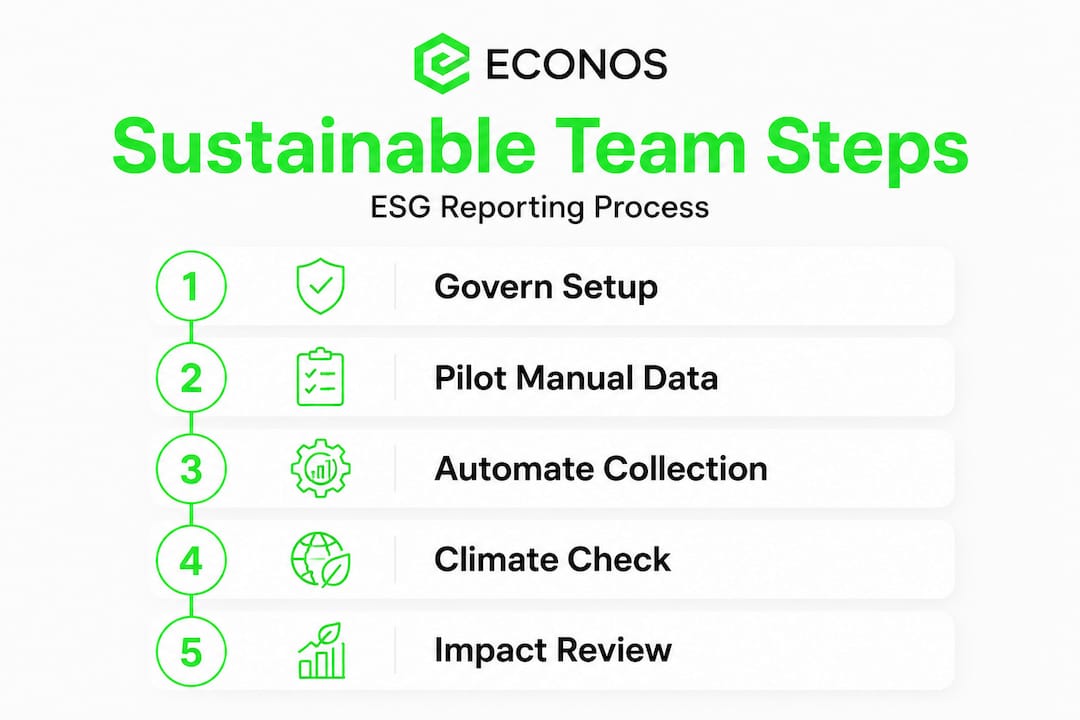
One detail that catches many teams off guard: auditors frequently flag missing justification fields for Scope 3 categories and offset treatments. If your data model doesn’t include a field for “why this category was included or excluded,” your disclosure may fail assurance even if the numbers are correct. Build that logic into the model from day one.
Practical data governance steps for sustainable teams:
- Appoint single data owners per ESG metric, not per department. Shared ownership creates redundancy and confusion in decentralized teams.
- Involve IT from month one, not after the reporting framework is already designed. The format your sustainability team wants often conflicts with how data actually lives in ERP and HR systems.
- Run a manual pilot before investing in ESG software. Map every data point manually first so you understand what you’re automating.
- Build audit trails into your data model from the start, including justification fields, source documentation, and version control.
- Test your Scope 3 completeness using the green reporting framework relevant to your sector before finalizing disclosures.
Pro Tip: When designing your data collection process, mirror the controls your finance team uses for statutory reporting. Use the same approval workflows, the same version tracking, and the same sign-off logic. This isn’t overkill. It’s what auditors expect, and it significantly reduces the back-and-forth during assurance.
Maintaining team capacity and psychological safety under CSRD pressures
Here is something most CSRD guides won’t tell you: the people problem is harder than the data problem. And it surfaces faster.

Workload imbalance is endemic in sustainability teams handling complex ESG programs. One person manages Scope 3 data collection across fifty suppliers. Another handles stakeholder materiality interviews while simultaneously drafting governance disclosures. When the workload isn’t visible to leadership, it doesn’t get addressed. And when it doesn’t get addressed, people leave.
James Hanson at ICS Lawyer makes a point that resonates with anyone who has managed a compliance program under real pressure:
“Quarterly team climate checks surface workload imbalances before they become turnover. Psychological safety is not a soft benefit. It is a compliance risk management tool.”
Sustainable team practices don’t require expensive interventions. They require consistency. Here is what works:
- Quarterly team climate checks: Structured, brief conversations about workload, clarity, and morale. Not performance reviews. Something closer to a retrospective.
- Deliberate recognition of process wins: Celebrating when a data model survives audit scrutiny or when a supplier response rate hits target reinforces the right behaviors.
- Open dialogue about capacity limits: Normalizing the phrase “I don’t have bandwidth for this right now” prevents the silent accumulation of undone work.
- Workload mapping before new obligations land: Every new ESRS standard or national amendment adds scope. Map the additional hours before assigning them.
Quarterly climate checks normalize candor in ESG teams, which matters because candor is exactly what you need when something is going wrong with data quality or a reporting timeline is slipping.
Pro Tip: Pair your quarterly climate check with a brief workload visualization exercise. Ask each team member to map their active obligations against available hours. The gaps become visible immediately and give managers something concrete to escalate to leadership.
Building a sustainable team culture also means making the connection between individual work and real-world impact explicit. People tolerate hard work when they understand why it matters. Linking CSRD compliance to business value is not just a communications exercise. It’s a retention strategy.
Coordinating stakeholders and governance for double materiality assessments
Double materiality is the CSRD concept that requires companies to assess both how sustainability issues affect the business (financial materiality) and how the business affects the environment and society (impact materiality). Getting this assessment right requires more functions than most teams initially involve.
A well-designed CSRD steering committee typically includes:
- Sustainability or RSE lead: Owns the overall CSRD program and coordinates between functions.
- Compliance officer: Ensures alignment between ESG disclosures and legal obligations.
- Data protection officer (DPO): In France especially, DPO expertise on RGPD is essential because ESG data collection risks dual sanctions if it doesn’t comply with personal data rules.
- HR lead: Contributes workforce and social data, and helps manage team capacity.
- CFO or finance representative: Bridges ESG metrics with financial reporting structures.
The DPO integration point surprises many managers. Every CSRD data treatment needs cross-validation between the DPO and RSE functions to establish legal bases under RGPD, especially for supply chain data involving individual supplier contacts or employee-level information. Committees handling this typically meet monthly to arbitrate data collection approaches.
Double materiality assessments require coordination across many stakeholders and data governance rigor comparable to finance. Without monthly governance meetings, the assessment tends to drift, with different functions operating on different materiality assumptions that only surface during the final disclosure review.
Centralized vs. decentralized committee structures each have tradeoffs:
| Approach | Strengths | Risks |
|---|---|---|
| Centralized committee | Faster decisions, clearer accountability | Single point of failure, bottlenecks |
| Decentralized committee | More buy-in across business units | Coordination overhead, inconsistent data standards |
| Hybrid model | Balances speed with inclusion | Requires strong governance protocol |
For most mid-size companies in Romania and France, a hybrid model works best: a core steering committee with monthly meetings and designated representatives in each business unit who feed data upward. The green consultation framework for ESG compliance supports this structure well. Your sustainability reporting checklist should map each double materiality data point to the function responsible for it.
For deeper guidance on employee engagement in ESG programs, including how to bring non-sustainability functions into the process without overwhelming them, external resources can complement your internal governance work.
Why traditional compliance approaches fail team sustainability — and what really works
We’ve seen this pattern repeatedly across five-plus years of CSRD preparation work. A company receives notice of its reporting obligations. Leadership assigns the task to the sustainability manager and, in many cases, adds it to an existing role without additional headcount. The first reporting cycle becomes a heroic effort. The second one breaks someone.
The core problem is that compliance-driven mindsets treat team sustainability as a byproduct of regulatory adherence rather than as a prerequisite for it. Depleted teams produce reactive compliance, not quality disclosure. The governance structures that ESRS 2 requires at board level exist precisely because program failures typically trace back to inadequate oversight, not inadequate effort from the team.
The companies that get this right are doing something different. They treat their sustainability team’s health with the same seriousness as their carbon data accuracy. They hold quarterly climate checks as a governance ritual, not an optional HR activity. And they make the business case for sustainability culture explicitly, not as a values statement, but as a risk management argument.
Embedding sustainable team culture means acknowledging that the people interpreting ESRS standards, negotiating with auditors, and managing supplier data requests carry significant institutional knowledge. Losing one experienced team member mid-cycle is not just a morale problem. It is a disclosure risk. The long-term value of CSRD compliance only materializes when teams are stable, skilled, and supported.
We admire what organizations like the Verdant Institute are building around sustainable organizational programs. The lesson is consistent: systems built on people who are resourced and respected outlast systems built on compliance pressure alone.
How ECONOS can help your sustainability team thrive
Building a team sustainability program that meets CSRD and ESRS requirements is not a one-time project. It is an ongoing operational commitment, and getting the foundations right from the start saves significant cost and stress later.
ECONOS works with mid-size and large companies in Romania and France to build exactly this kind of foundation. Our ESG reporting services cover governance setup, double materiality assessments, and audit-ready disclosure, tailored to local regulatory requirements. Our carbon footprint assessment methodology aligns directly with ESRS E1 requirements, including Scope 1, 2, and 3 data collection and justification documentation. And when you need to move from advisory to full compliance readiness, our team helps you comply with EU law without building a dependency on outside consultants. We train your people to run this themselves.
Frequently asked questions
What is team sustainability in the context of ESG reporting?
Team sustainability means maintaining a well-governed, adequately resourced, and resilient sustainability team capable of managing ESG data and regulatory compliance over time, without burnout or knowledge loss between reporting cycles.
How does the CSRD affect sustainability team responsibilities in Romania and France?
CSRD requires teams to implement governance structures, manage complex double materiality assessments, and report detailed ESG data. In Romania, large companies must report starting FY 2024, and France follows the same EU timeline with FY 2024 data due in 2025, significantly increasing coordination demands on sustainability teams.
What are common challenges for sustainability teams under ESRS standards?
The most frequent challenges are fragmented data ownership, data models that weren’t built with audit justification fields, workload imbalance, and the complexity of double materiality coordination. Clear data ownership and pilot phases prevent the most costly failures, and quarterly climate checks address the human dimension before it becomes a turnover event.
How can companies maintain psychological safety in sustainability teams?
By conducting regular team climate checks, promoting open communication, balancing workloads visibly, and recognizing process achievements, companies reduce burnout risk and retain the institutional knowledge that makes ESG programs function. Quarterly checks normalize candor and give managers early warning before problems escalate.
What role do data protection officers (DPOs) play in ESG reporting?
DPOs ensure that ESG data collection complies with RGPD rules, preventing legal exposure by cross-validating data treatments for sensitive information. In France, DPOs are essential for CSRD governance committees, particularly when collecting supply chain data that involves personal information about individuals at supplier organizations.