
.png)

TL;DR:
- CSRD mandates sustainability reporting for EU companies and impacts their suppliers globally.
- Suppliers must gather data on emissions, labor practices, and supply chain traceability.
- The 2026 Omnibus Directive raises thresholds and introduces simplified standards for small and SME suppliers.
If you supply goods or services to an EU-based company, CSRD is already knocking at your door. Suppliers outside the EU face indirect obligations via CSRD-driven data requests from their EU customers, even if no direct legal duty applies to them. That means manufacturers in Hanoi or Cluj alike are fielding sustainability questionnaires, carbon data requests, and audit demands they were not prepared for. This article breaks down who is affected, what data you need to collect, how the Omnibus Directive 2026 reshapes the rules, and what practical steps you can take right now to turn compliance pressure into a competitive edge.
Table of Contents
- How CSRD impacts suppliers inside and outside the EU
- Key reporting requirements and expectations under the CSRD
- Common challenges and how to overcome them in Romania and Vietnam
- Omnibus Directive 2026: What changes for non-EU and SME suppliers
- What most CSRD guides get wrong about supply chain transparency
- Get expert help for CSRD compliance
- Frequently asked questions
Key Takeaways
| Point | Details |
|---|---|
| Indirect impact is real | Even suppliers outside the EU are being asked for CSRD data by customers. |
| Know your obligations | CSRD sets clear thresholds, but value chain reporting cascades beyond direct scope. |
| Map your data now | Suppliers can get ahead by proactively organizing emission, labor, and traceability information. |
| Regulatory changes matter | The Omnibus Directive raises thresholds and offers relief for smaller suppliers. |
| Go beyond compliance | Strategic transparency can build stronger business relationships, not just avoid penalties. |
How CSRD impacts suppliers inside and outside the EU
Now that you know why suppliers cannot ignore CSRD, let’s break down its direct and indirect effects.
The Corporate Sustainability Reporting Directive (CSRD) sets mandatory sustainability reporting rules for companies operating in or trading with the EU. Direct obligations apply to companies meeting at least two of three thresholds: 250 or more employees, €50 million in turnover, or €25 million in total assets. In Romania alone, approximately 5,300 companies are affected from 2025 onward under these thresholds.
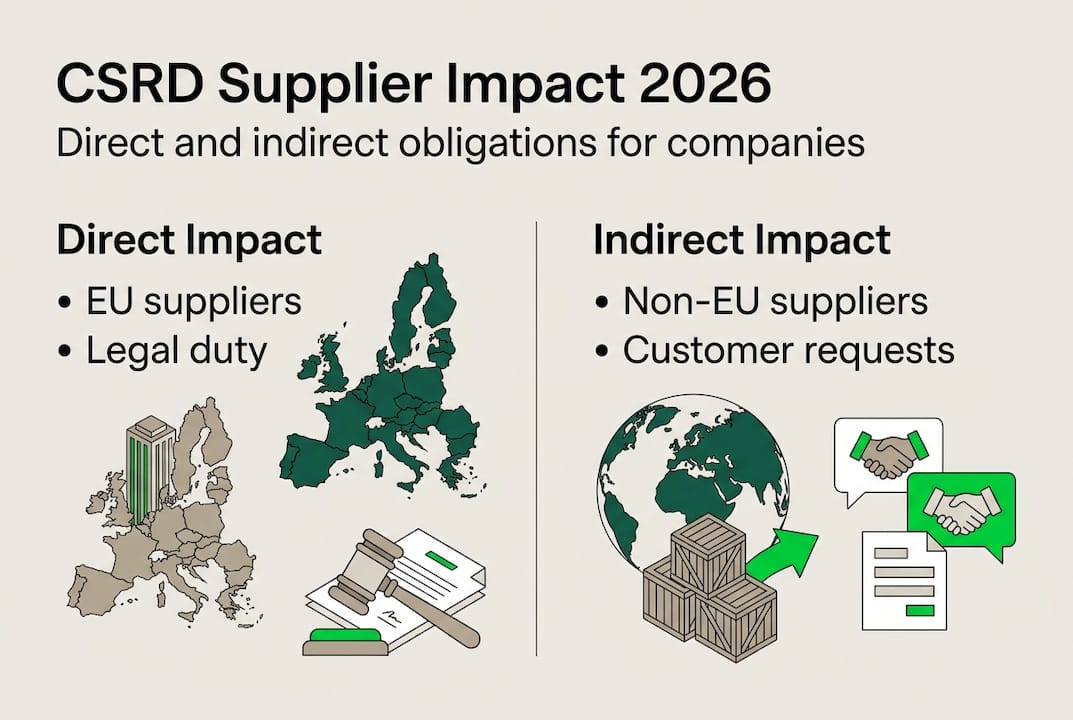
But the reach goes further. CSRD requires value chain disclosures under the European Sustainability Reporting Standards (ESRS), which means in-scope companies must collect and report data from their direct and indirect suppliers. Even if you are a tier-2 or tier-3 supplier in Vietnam with no EU legal presence, your EU customer’s CSRD obligation flows downstream to you.
Here is how the two types of obligations differ:
| Obligation type | Who it applies to | What it requires |
|---|---|---|
| Direct legal obligation | EU companies above CSRD thresholds | Full ESRS reporting, double materiality, assurance |
| Indirect supply chain pressure | Non-EU suppliers, SMEs below thresholds | Data packs, GHG figures, labor evidence, policy documents |
For Romanian suppliers in scope, the path is clear: you must report. For Vietnamese suppliers, the pressure is commercial. Lose the ability to answer your EU customer’s data request, and you risk losing the contract.
Key areas where supplier data is typically requested:
- Greenhouse gas emissions (Scope 1, 2, and Scope 3 from the buyer’s perspective)
- Labor practices including wages, working hours, and health and safety records
- Environmental policies and certifications
- Traceability documentation for raw materials
- Remediation evidence when issues are identified
For a broader view of how ESG requirements affect your export relationships, the ESG export compliance guide from ECONOS is a practical starting point. You can also review the ESRS standards introduction to understand what your EU customers are actually required to disclose.
Key reporting requirements and expectations under the CSRD
Knowing how you are affected, let’s explore exactly what information you will need to gather and report.
The CSRD is built around a concept called double materiality. This means companies, and by extension their suppliers, must assess sustainability topics from two angles: the impact your business has on people and the environment, and the financial risks and opportunities that sustainability issues create for your business. Both lenses matter. Neither can be ignored.
CSRD double materiality, combined with ESRS E1 (climate) and ESRS S2 (workers in the value chain), creates a clear framework for what suppliers need to document. ESRS E1 covers your carbon footprint, energy use, and climate transition plans. ESRS S2 focuses on labor rights, living wages, and working conditions across the supply chain.
Here is a step-by-step approach to building your compliance readiness:
- Map your value chain. Identify all direct and indirect suppliers, their locations, and the sustainability risks associated with each tier.
- Identify relevant data points. Prioritize GHG emissions (especially Scope 3), labor indicators, and environmental certifications.
- Run a risk assessment. Score suppliers by geography, sector, and known ESG risk factors.
- Document policies and targets. Collect codes of conduct, environmental policies, and any remediation actions taken.
- Prepare a reusable evidence pack. Structure your data so it can be shared quickly with multiple EU customers requesting similar information.
The table below shows which ESRS standards are most relevant for supplier data requests:
| ESRS standard | Topic | Typical supplier data requested |
|---|---|---|
| E1 | Climate | Scope 1, 2, 3 emissions, energy consumption |
| S2 | Value chain workers | Wages, hours, safety incidents, grievance mechanisms |
| G1 | Business conduct | Anti-corruption policies, supplier codes of conduct |
For a detailed walkthrough of supply chain due diligence requirements, the Council on Fire resource is worth bookmarking. The ESG workflow for manufacturers guide from ECONOS also walks through how to operationalize these steps inside your organization.
Pro Tip: Build one master evidence pack with your GHG data, labor policies, and certifications. Update it annually. When three EU customers ask for the same information in the same quarter, you will be ready in hours, not weeks.
Common challenges and how to overcome them in Romania and Vietnam
Now we will look at practical barriers, plus how leading suppliers are closing the gap.

The readiness gap is real and measurable. In Romania, banks cover 100% of climate and own workforce disclosures, but only 29% address value chain disclosures. In Vietnam, tier-3 supplier readiness for CSRD data requests sits as low as 4% to 12%. These numbers are not just statistics. They represent contracts at risk.
The most common barriers suppliers face include:
- Data gaps: No system for tracking energy consumption, waste, or labor hours at the facility level
- Survey fatigue: Multiple EU customers sending different questionnaires with overlapping but inconsistent questions
- Unclear scope: Confusion about whether indirect obligations actually apply and what level of detail is expected
- Lack of evidence: Policies exist on paper but are not documented, audited, or verified
- Resource constraints: Especially acute for mid-size manufacturers without a dedicated sustainability team
For Vietnamese suppliers navigating EU sustainability due diligence rules, the path forward involves three practical steps: first, understand which EU customers are in scope and what they need; second, build basic data collection systems for energy, emissions, and labor; third, seek third-party verification to add credibility to your responses.
For Romanian manufacturers, the challenge is less about awareness and more about execution. You may know what CSRD requires, but translating that into operational data collection across a multi-site supply chain is genuinely difficult. The sustainable supply chain ESG examples resource from ECONOS shows how peer companies are solving this. Understanding Scope 3 emissions is also critical, since that is where most supplier data requests originate.
“Human rights and value chain disclosures are no longer optional extras. They are becoming the baseline expectation for any supplier that wants to remain in an EU-connected supply chain.”
Pro Tip: Use standardized calculation tools and pre-built checklists rather than building everything from scratch. Tools like ECONOS’s AVA assistant help you collect and calculate emissions data autonomously, reducing the time and expertise required.
Omnibus Directive 2026: What changes for non-EU and SME suppliers
With challenges in focus, it is critical to understand regulatory changes that may ease or reshape supplier compliance.
The EU Omnibus Directive, published in 2026, introduces significant changes to CSRD thresholds and reporting mechanics. Omnibus 2026 raises reporting thresholds, introduces simplified SME and VSME (Very Small and Micro Enterprise) responses, and allows limited assurance for a transitional period of three years.
The most important threshold change: companies must now have more than 1,000 employees or exceed €450 million in turnover to fall under full CSRD obligations. This removes a significant number of mid-size companies from direct scope, but it does not remove them from supply chain data requests.
Here is how the pre and post-Omnibus landscape compares for suppliers:
| Factor | Pre-Omnibus | Post-Omnibus 2026 |
|---|---|---|
| Employee threshold | 250+ | 1,000+ |
| Turnover threshold | €40M | €450M |
| SME reporting | Full ESRS | VSME simplified standard |
| Assurance level | Reasonable assurance | Limited assurance (3 years) |
| Non-EU supplier requests | Unrestricted data requests | Capped info requests for SMEs |
For non-EU suppliers, the Omnibus introduces a key protection: in-scope companies cannot demand more information from SME suppliers than what the VSME standard covers. This is meaningful for smaller Vietnamese manufacturers who were facing open-ended data requests with no clear boundaries.
Action steps for SMEs and non-EU suppliers under the new rules:
- Review whether your EU customers are still in scope under the new 1,000-employee threshold
- If you qualify as an SME or VSME, familiarize yourself with the VSME reporting standard to understand what you can and cannot be asked
- Use the phased assurance window to build your data systems before full verification is required
- Review the Omnibus Directive overview for a full breakdown of what changed and why
The ESRS reporting changes page also summarizes how standards are evolving under the Omnibus.
What most CSRD guides get wrong about supply chain transparency
Before you take your next steps, here is what most compliance guides miss, and how you can truly get ahead.
Most CSRD guides treat supplier compliance as a defensive exercise. Gather the data, answer the questionnaire, avoid losing the contract. That framing is understandable, but it leaves real value on the table.
An IMD study on CSRD found that while CSRD increases comparability across companies, there remains a significant gap between materiality assessment and actual business strategy. In other words, companies are reporting but not integrating. Suppliers who close that gap first gain a genuine advantage.
When you proactively share sustainability data, you become easier to work with. You reduce your customer’s compliance burden. You build trust that outlasts any single contract. That is not idealism. That is relationship capital.
The suppliers who will win in the next five years are not the ones who pass audits. They are the ones who embed sustainability into their onboarding process, their contracts, and their supplier relationships before anyone asks them to. Reviewing a carbon footprint reduction checklist or building a structured ESG workflow are not compliance tasks. They are strategic investments.
Pro Tip: Embed sustainability clauses into new supplier contracts now. When your EU customers update their own requirements, you will already have the data and the documentation to respond without scrambling.
Get expert help for CSRD compliance
To make your CSRD journey easier, here is where you can get direct expert support.
CSRD compliance does not have to be a guessing game. At ECONOS, we work with mid-size and large manufacturers in Romania and Vietnam to close exactly the gaps described in this article. Whether you need structured ESG reporting support, a full carbon footprint analysis covering Scope 1, 2, and 3, or help preparing for EcoVadis certification, our team builds your internal capacity rather than creating dependency.
We have completed over 158 projects across 17 industries, and we hold a Gold EcoVadis rating ourselves. If you want practical, honest guidance tailored to your supply chain, reach out to us. We will help you understand what you are doing and why, not just hand you a report.
Frequently asked questions
What is the CSRD and who is directly affected?
The CSRD is the EU’s Corporate Sustainability Reporting Directive. It applies directly to EU companies meeting at least two of three thresholds: 250+ employees, €50M turnover, or €25M in total assets, with the Omnibus 2026 raising the employee threshold to 1,000.
If I am a supplier in Vietnam, do I need to comply with CSRD?
You may not have a direct legal obligation, but Vietnamese suppliers face indirect CSRD requests via their EU customers’ value chain reporting requirements, which can put contracts at risk if you cannot provide the requested data.
What data are suppliers typically required to provide?
Data requests include Scope 3 GHG emissions, labor standards evidence, and value chain traceability documentation, with the exact scope depending on your customer’s ESRS materiality assessment.
How does the Omnibus Directive 2026 affect smaller suppliers?
The Omnibus raises thresholds to 1,000 employees and introduces VSME simplified reporting, which limits what in-scope companies can demand from SME suppliers and reduces the overall compliance burden for smaller businesses.
What’s the difference between CSRD and CSDDD for suppliers?
CSRD is disclosure, CSDDD is due diligence; CSRD requires you to report sustainability information, while the Corporate Sustainability Due Diligence Directive requires active identification and management of human rights and environmental risks across the value chain.