
.png)

TL;DR:
- Effective sustainability risk management requires strong governance, comprehensive dual-materiality assessments, and integration into core business decisions. Transparent reporting, clear targets, and ongoing reviews build trust and ensure the framework remains practical and impactful. Leadership authority and honest acknowledgment of data gaps are essential to prevent frameworks from becoming ineffective reports.
Step by step sustainability risk management is the process of systematically identifying, assessing, and mitigating environmental, social, and governance (ESG) risks to embed sustainability into core business risk practices. The industry term for this discipline is integrated sustainability risk management, and it sits at the intersection of enterprise risk management (ERM) and ESG strategy. Done well, it protects capital, satisfies regulators, and builds stakeholder trust. Done poorly, it produces reports nobody reads and governance structures nobody respects. This guide gives managers and executives a practical workflow to build something that actually works.
What are the essential governance and scope-setting steps?
A sustainability risk framework fails if it stays inside the sustainability function. It must live inside governance bodies that hold real decision authority. That is the non-negotiable starting point.

Build a cross-functional governance council first. This council should include representatives from finance, operations, legal, procurement, and the C-suite. It sets risk thresholds, approves disclosures, and enforces remediation accountability. Without that authority, sustainability risk stays a reporting exercise rather than a management discipline.
Once governance is in place, define your scope clearly:
- Business units and assets: Which facilities, product lines, or subsidiaries face material ESG exposure?
- Supply chain tiers: Scope 3 emissions and social risks often concentrate in Tier 2 and Tier 3 suppliers, as companies like Michelin and PORR have discovered when mapping their value chains.
- Time horizons: Short-term (2026–2030), medium-term (2030–2040), and long-term (2040–2050) exposures require different responses.
- Regulatory perimeter: CSRD, ESRS, EU Taxonomy, and CBAM each impose distinct scope requirements that must be reflected in your governance mandate.
A common pitfall is assigning ESG data ownership to a single analyst with no authority to compel other departments to provide data. Assign ownership at the department head level, with clear accountability for data quality and timeliness.
Pro Tip: Start your governance council with a one-page risk mandate that defines what decisions require council approval. Ambiguity about authority is the fastest way to kill momentum.
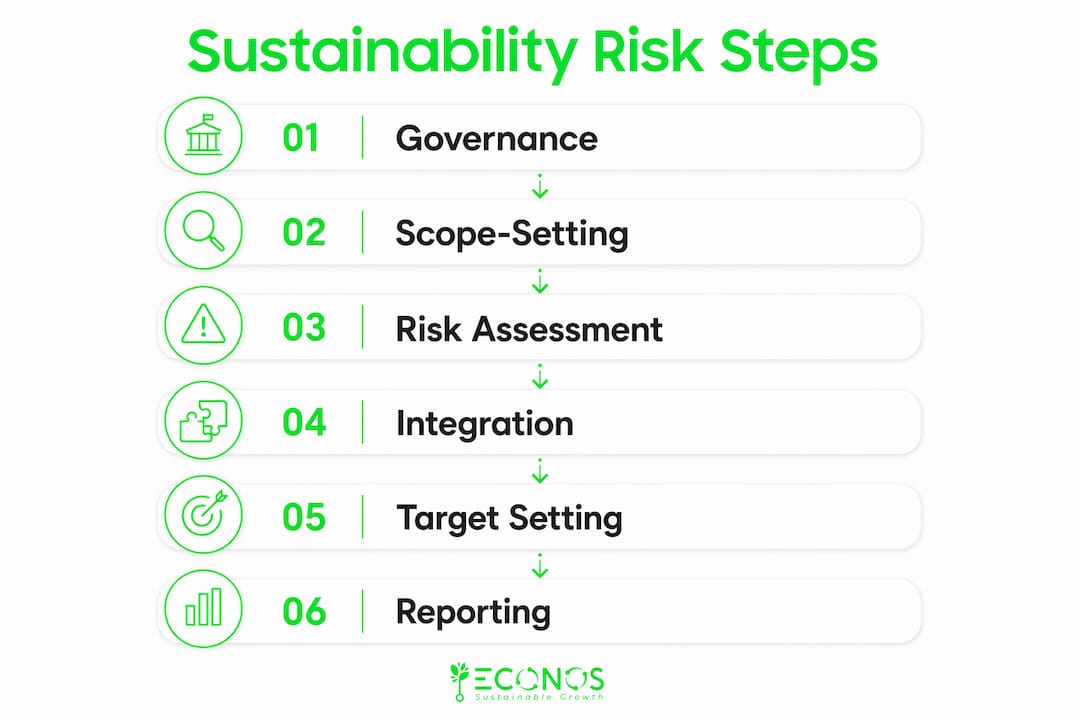
How to conduct double materiality and sustainability risk assessments
Double materiality is the principle that organizations must assess both how sustainability issues affect the business financially and how the business affects society and the environment. The European Sustainability Reporting Standards (ESRS) require this dual lens. IFRS S2 focuses on the financial impact side. Both perspectives belong in your assessment workflow.
Follow these steps in sequence:
- Map your stakeholders. Identify investors, regulators, customers, employees, and affected communities. Their concerns shape which topics are material. Use structured surveys and interviews, not assumptions.
- Identify physical and transition risks. Climate risk divides into physical risks such as floods and heatwaves, and transition risks such as carbon pricing shifts and policy changes. Both require distinct assessment approaches and mitigation strategies.
- Run scenario analysis across two climate pathways. Effective scenario analysis requires evaluating at least a Paris-aligned 1.5°C scenario and a business-as-usual 3°C+ scenario, projecting financial resilience through 2030, 2040, and 2050. Many firms use NGFS Phase V scenarios as their reference model.
- Score and prioritize risks. Rate each risk by probability, financial magnitude, and time horizon. A simple heat map works at first. Refine it as data quality improves.
- Document data gaps honestly. Openly presenting uncertainties increases stakeholder trust more than overstating data quality. Disclose limitations in your assessment output rather than hiding them.
For nature-related risks, the TNFD’s LEAP methodology (Locate, Evaluate, Assess, Prepare) provides a structured, iterative approach that produces disclosure-ready assessments with integrated financial risk quantifications.
| Assessment Dimension | Key Question | Primary Standard |
|---|---|---|
| Financial materiality | How does this risk affect revenues, costs, or asset values? | IFRS S2 |
| Impact materiality | How does our activity affect people and ecosystems? | ESRS |
| Physical risk | What climate events threaten our assets and operations? | NGFS scenarios |
| Transition risk | What policy, market, or technology shifts affect our model? | NGFS scenarios |
| Nature and biodiversity | Where do we depend on or impact natural systems? | TNFD LEAP |
Pro Tip: Scenario analysis must go beyond a regulatory checkbox. Tailor each scenario to your specific business context and feed the outputs directly into capital allocation decisions. Otherwise, the exercise produces a document, not a decision.
How to integrate sustainability risk into core business decisions
Embedding sustainability risk insights into business decisions is where most organizations stall. The assessment is done. The report is written. Then nothing changes in how capital gets allocated or how suppliers get selected. That gap is a governance failure, not a data failure.
Embedding sustainability risks where decisions are made ensures risk thresholds and remediation are managed effectively, reducing silos. Here is how to make that happen in practice:
- Capital allocation: Require ESG risk scores as a mandatory input for any investment above a defined threshold. Raiffeisen Bank, for example, integrates climate risk into credit assessments for large corporate loans.
- Procurement and supplier management: Map Scope 3 emissions and social risks to supplier tiers. Use EcoVadis ratings or equivalent assessments to score suppliers and set minimum thresholds for new contracts.
- Mergers and acquisitions: Add a sustainability risk due diligence module to your M&A checklist. Stranded asset risk and regulatory exposure can materially affect deal valuations.
- Align with COSO ERM: The Committee of Sponsoring Organizations (COSO) framework provides a recognized structure for mapping sustainability controls to enterprise risks and linking mitigation actions to risk owners.
Dashboards are the operational backbone of this integration. Dashboards are effective only if they drive behavioral change, requiring recurring leadership reviews that focus on the quality of closure for overdue remediation actions. A dashboard that leadership never reviews is a symptom of implementation failure.
| Integration Approach | Strength | Limitation |
|---|---|---|
| ESG risk scoring in investment decisions | Directly links sustainability to capital | Requires consistent scoring methodology |
| Supplier ESG assessments (EcoVadis) | Quantifies supply chain exposure | Coverage gaps in Tier 2 and beyond |
| COSO ERM alignment | Recognized governance structure | Requires cross-department coordination |
| Leadership risk dashboards | Drives accountability and closure | Only effective with active executive engagement |
What are best practices for setting targets and reporting?
Measurable targets transform a sustainability risk assessment from a one-time exercise into a living management system. Without targets, there is no accountability. Without reporting, there is no trust.
Follow this sequence to build an audit-ready reporting process:
- Set science-based targets. Align emissions reduction targets with the Science Based Targets initiative (SBTi) methodology for Scope 1, 2, and 3. Add adaptation metrics for physical risks, such as percentage of assets assessed for flood exposure by 2028.
- Map internal metrics to reporting standards. Audit-ready sustainability reporting depends on mapping data collection workflows to ESRS and IFRS S2, with defined roles and automated disclosures to protect data integrity. Assign a named owner to every metric.
- Build a data collection workflow. Define data sources, collection frequency, validation rules, and escalation paths for missing data. Platforms like SAP Sustainability Control Tower support this at enterprise scale.
- Prepare for limited assurance. Third-party assurance of sustainability disclosures is now required under CSRD for large companies. Structure your documentation and controls to support that process from the start. Econos-esg’s sustainability reporting checklist offers a practical starting point for compliance readiness.
- Report honestly, including limitations. Disclose data gaps, estimation methods, and areas of uncertainty. Stakeholders and auditors both reward transparency over false precision.
Treat your sustainability risk framework as a living document. Review it annually, update it after major regulatory changes, and revise it whenever your business model shifts significantly.
Which common challenges arise and how do you overcome them?
Every organization hits the same obstacles when building a sustainability risk management workflow. Knowing them in advance saves months of frustration.
- Data fragmentation: Different business units using inconsistent naming for the same suppliers or assets destroys dashboard confidence. Establish a single source of truth with consistent entity identifiers across procurement, EHS, and ESG systems. Taxonomy alignment is not glamorous work, but it is foundational.
- Governance silos: Sustainability teams often lack the authority to compel finance or operations to act on risk findings. The solution is structural: put sustainability risk on the agenda of the executive risk committee, not just the sustainability committee.
- Executive buy-in: Frame sustainability risk in financial terms. Carbon pricing exposure, regulatory fines, and supply chain disruption costs are language that CFOs and CEOs respond to. Abstract environmental arguments rarely move capital allocation decisions.
- Reporting as a formality: Reports that sit unread indicate that the framework has become a compliance exercise. Connect every reported metric to a decision or a remediation action. If a metric does not drive a decision, question whether it belongs in the report.
- AI tools used carelessly: AI-powered sustainability reporting workflows function best as multi-stage agents where an adversarial model reviews initial outputs to detect inconsistencies before human review. Use AI to accelerate drafting and data collection, not to replace judgment or audit trails.
Pro Tip: Momentum dies between annual reporting cycles. Schedule quarterly governance council reviews with a standing agenda item for sustainability risk. Treat it like a financial risk review, not a sustainability update.
Key takeaways
Effective step by step sustainability risk management requires governance with real authority, honest assessment of both financial and impact materiality, and direct integration into the decisions that allocate capital and select suppliers.
| Point | Details |
|---|---|
| Governance comes first | A cross-functional council with decision authority is the foundation of any working framework. |
| Double materiality is non-negotiable | Assess both how ESG risks affect your business and how your business affects the world. |
| Scenario analysis must feed decisions | Run 1.5°C and 3°C+ scenarios and connect outputs directly to capital allocation choices. |
| Transparency builds trust | Disclosing data gaps and uncertainties earns more stakeholder confidence than overstating data quality. |
| Treat the framework as living | Annual reviews, quarterly governance check-ins, and honest reporting keep the system from becoming a formality. |
Why governance authority is the real test of any ESG framework
I have worked with companies that had beautifully designed sustainability risk frameworks. Detailed materiality matrices, scenario analyses with three climate pathways, dashboards with real-time data feeds. And yet, when a major procurement decision came up, nobody consulted the framework. The sustainability team found out about the new supplier after the contract was signed.
That experience taught me something I now consider the most honest test of any ESG framework: does it get consulted before decisions are made, or after? If it is after, you have a reporting system, not a risk management system. The difference matters enormously.
The organizations I have seen get this right share one trait. Their sustainability risk council has the authority to delay a capital decision pending an ESG review. Not recommend. Not advise. Delay. That structural power changes behavior faster than any training program or dashboard upgrade.
I also want to be direct about data gaps. Every organization I have worked with has them. The temptation is to paper over them with estimates and present a clean picture. Resist that temptation. Acknowledging a data gap in a disclosure is not a weakness. It is a signal that your organization understands its own limitations and is working to close them. Auditors and sophisticated investors read it that way too.
The practical advice I keep returning to: start smaller than you think you need to, build governance authority before you build data infrastructure, and report honestly from day one. The framework will grow. The credibility you build by being transparent early is much harder to rebuild once it is lost.
— Mathieu
How Econos-esg can support your sustainability risk journey
Building a sustainability risk management workflow from scratch is a significant undertaking. Econos-esg has completed over 158 projects across 17 industries, working with companies like Michelin, eMAG, and Raiffeisen Bank to build frameworks that are practical, compliant, and built to last.
Whether you need a carbon footprint assessment to anchor your physical and transition risk analysis, or full ESG reporting support under CSRD and ESRS, Econos-esg builds internal capacity in your team rather than creating dependency on external consultants. The goal is always the same: you understand what you are doing and why. Reach out to Econos-esg to discuss where your organization stands and what a practical next step looks like.
FAQ
What is double materiality in sustainability risk management?
Double materiality requires organizations to assess both how ESG issues affect their financial performance and how their activities impact society and the environment. ESRS mandates this dual assessment for companies subject to CSRD.
How many climate scenarios should we analyze?
Effective scenario analysis requires at least two climate scenarios, typically a Paris-aligned 1.5°C pathway and a business-as-usual 3°C+ pathway, evaluated across 2030, 2040, and 2050 time horizons.
What is the LEAP methodology?
LEAP (Locate, Evaluate, Assess, Prepare) is a structured, iterative approach developed by the TNFD for assessing nature and biodiversity risks. It produces disclosure-ready assessments with integrated financial risk quantifications.
How do we prevent sustainability reporting from becoming a formality?
Connect every reported metric to a specific decision or remediation action, and schedule recurring leadership reviews focused on the quality of closure for overdue actions. Reports that leadership never acts on signal implementation failure.
What standards should guide our sustainability risk reporting?
Map your data collection and disclosures to ESRS for impact and financial materiality under CSRD, and to IFRS S2 for climate-related financial disclosures. Assign a named owner to every metric and build workflows that support limited assurance from the start.