
.png)

TL;DR:
- Pharmaceutical sustainability now requires regulated environmental risk assessments, lifecycle assessments, and supply chain management.
- Industry leaders like AstraZeneca operationalize sustainability through data-driven tools such as the Product Sustainability Index, linking environmental metrics directly to product decisions.
Pharmaceutical sustainability is defined as the strategic integration of environmentally responsible manufacturing, regulatory compliance, and green innovation across the entire life cycle of medicinal products. The field has shifted decisively from voluntary corporate social responsibility to a regulated discipline with measurable performance requirements. Key frameworks now shaping the industry include Environmental Risk Assessments mandated by the UK MHRA, Extended Producer Responsibility obligations under EU Directive 2024/3019, and lifecycle-based indices like AstraZeneca’s Product Sustainability Index. Understanding how these frameworks connect is no longer optional for pharmaceutical professionals. It is a compliance requirement with financial consequences.
What is pharmaceutical sustainability and why does it matter in 2026?
Pharmaceutical sustainability has evolved from a peripheral CSR task into a core regulatory and operational discipline, centered on lifecycle assessments, green chemistry, and measurable environmental performance. This shift is driven by converging regulatory pressure from the UK MHRA, the European Medicines Agency, and the European Commission, all of which now require documented environmental analysis as part of product authorization and post-market management.
The impact of pharmaceuticals on the environment is well documented. Active pharmaceutical ingredients (APIs) discharged into waterways disrupt aquatic ecosystems, and manufacturing processes generate significant greenhouse gas emissions, solvent waste, and water consumption. Scope 3 emissions, which include outsourced API synthesis and raw material extraction, dominate the carbon footprints of most major pharmaceutical companies.
The business case is equally clear. Companies that embed sustainability data into product decisions reduce regulatory rework, manage EPR fee exposure, and attract ESG-conscious investors and partners. Sustainability is a risk management tool, not an ideological exercise.
What is an Environmental Risk Assessment and why is it central to compliance?
An Environmental Risk Assessment (ERA) is a structured evaluation of the risks a pharmaceutical substance poses to the environment, covering physicochemical properties, ecotoxicological data, and environmental fate. As of April 2026, UK marketing authorization applications require a complete ERA, with specific mitigation measures documented in the Summary of Product Characteristics (SmPC) and Patient Information Leaflet (PIL) where risks are identified.
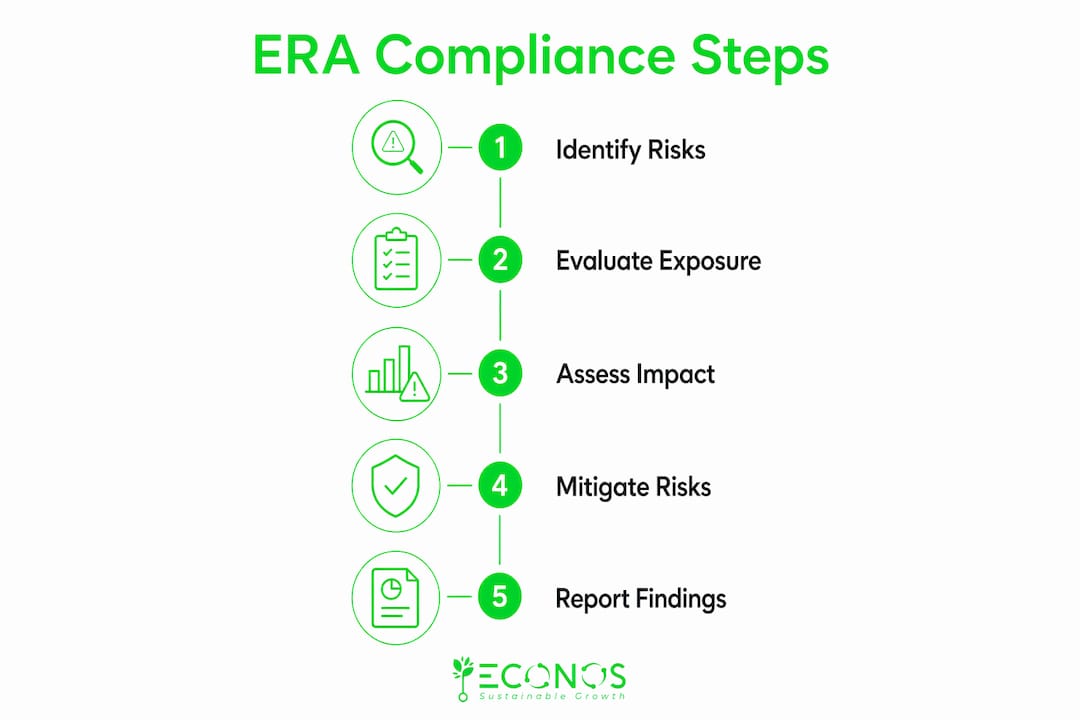
The MHRA’s ERA framework aligns with EMA’s 2024 guideline EMEA/CHMP/SWP/4447/00 Rev. 1, which requires predicted environmental concentration assessments based on UK-specific prevalence data. EU prevalence data is acceptable only when it produces a more conservative estimate than UK data. This distinction matters operationally: teams that default to EU datasets without verification risk submitting non-compliant ERAs.
A compliant ERA evaluates risk across three domains:
- Physicochemical properties: Water solubility, octanol-water partition coefficient, and vapor pressure inform exposure modeling.
- Ecotoxicological data: Acute and chronic toxicity to aquatic organisms, including fish, invertebrates, and algae.
- Environmental fate: Biodegradability, soil adsorption, and bioaccumulation potential determine persistence and spread.
Where risks are identified, the ERA must propose mitigation measures. These may include disposal guidance, packaging restrictions, or manufacturing process changes. The ERA is not a one-time submission. Post-approval changes that affect environmental exposure require ERA updates, making it a living document within the product lifecycle.
Pro Tip: Validate exposure data quality and prevalence assumptions early in development. The most common ERA pitfall is underestimating data quality requirements, which leads to regulatory rework and submission delays.
How do EU wastewater directives impact pharma manufacturers?
EU Directive 2024/3019, the revised Urban Wastewater Treatment Directive (UWWTD), introduces a structural shift in how pharmaceutical companies bear responsibility for environmental contamination. The directive mandates quaternary treatment at wastewater plants to remove micropollutants, with a minimum 80% removal efficiency required. It also introduces mandatory monitoring for PFAS and microplastics at plants serving populations above 10,000 person equivalents.
The most consequential element for pharmaceutical manufacturers is the Extended Producer Responsibility (EPR) scheme. Under this mechanism, pharma producers from end 2028 must collectively cover 80% of the costs of quaternary treatment and micropollutant monitoring. The remaining 20% is covered by cosmetics producers. This is not a voluntary contribution. It is a legally binding financial obligation tied directly to product portfolios.
The compliance timeline breaks down as follows:
- By December 31, 2027: The European Commission finalizes technical criteria for exemptions from EPR fees.
- By December 31, 2028: Pharma producers begin fee payments for wastewater treatment infrastructure.
- Ongoing: Mandatory PFAS and microplastics monitoring at qualifying treatment plants.
Exemptions are available, but they require documented evidence. Substances that are biodegradable or present below volume thresholds may qualify. The critical point is that exemption dossier preparation must begin now, before the Commission finalizes criteria in 2027. Companies that wait will face compressed timelines and higher financial exposure.
| Obligation | Deadline | Who is affected |
|---|---|---|
| EPR fee payments begin | December 31, 2028 | All pharma producers in EU market |
| Exemption criteria finalized | December 31, 2027 | Companies seeking fee reduction |
| Quaternary treatment monitoring | Ongoing from 2024 | Wastewater plants above 10,000 p.e. |
| PFAS and microplastics monitoring | Ongoing | Plants above 10,000 p.e. |
Pro Tip: Start portfolio characterization now. Map each substance’s biodegradability profile and volume data against the likely exemption criteria. Early characterization is the only way to build a credible exemption dossier before the 2027 deadline. Econos-esg’s guide on EPR compliance offers a practical starting framework.
What frameworks are industry leaders using to operationalize sustainability?
The most instructive example of operationalized pharmaceutical sustainability comes from AstraZeneca. The company’s Product Sustainability Index (PSI) is a multi-category scoring tool built on ISO 14040/14044 lifecycle assessment standards. By 2025, AstraZeneca had assessed 79% of its launched products by sales revenue using the PSI. That figure represents a genuine commitment to data-driven decision-making, not a headline metric.

The PSI scores products across five categories: greenhouse gas emissions, water use, API discharge risks, raw materials sourcing, and innovation. Each category generates an improvement plan, creating what sustainability practitioners call a metrics-to-decisions feedback loop. LCA outputs translate directly into product-level priorities, which then inform R&D, procurement, and manufacturing decisions. This is the architecture that makes sustainability operationally real rather than aspirationally stated.
Green chemistry is the manufacturing-side complement to lifecycle thinking. Process Mass Intensity (PMI) and solvent burden are the primary benchmarks for evaluating manufacturing routes. Solvents typically dominate PMI, making solvent substitution the highest-leverage intervention in green API manufacturing.
A concrete example: deep eutectic solvents for lidocaine synthesis, using a menthol and decanoic acid eutectic mixture for liquid-liquid extraction, achieved a 92% isolated yield while eliminating conventional organic solvents. This approach, assessed using standard green chemistry metrics, demonstrates that solvent reduction does not require sacrificing yield or scalability.
Key principles for operationalizing sustainable drug development include:
- Embed sustainability at the design stage. Decisions made in early-phase development lock in roughly 80% of a product’s lifetime environmental footprint. Waiting until manufacturing scale-up to address PMI or carbon intensity is expensive and often ineffective.
- Use PAS 2090 as a harmonization reference. This pharmaceutical lifecycle assessment standard provides a consistent methodology for comparing products and benchmarking progress across the industry.
- Align LCA scope with Scope 3 boundaries. API synthesis and outsourced manufacturing are both Scope 3 emission sources and LCA hotspots. Treating them as a single analytical domain avoids double-counting and improves decision quality.
Pro Tip: When commissioning an LCA for a pharmaceutical product, specify ISO 14040/14044 compliance and request a PMI breakdown by manufacturing stage. This gives you the data needed to prioritize green chemistry interventions where they will have the greatest impact. Econos-esg’s LCA services are built around exactly this kind of decision-grade output.
What are the main Scope 3 challenges in pharmaceutical supply chains?
Pharma sector alignment with 1.5°C carbon trajectories rose from 30% in 2024 to 52% in 2025, yet overall emissions continue rising. The reason is Scope 3. While companies make progress on Scope 1 and 2 through renewable energy procurement and energy efficiency, Scope 3 emissions from outsourced manufacturing, raw material extraction, and logistics remain largely outside direct operational control.
Scope 3 emissions in pharma are driven by several interconnected sources:
- API synthesis at contract manufacturing organizations (CMOs). Most large pharma companies outsource a significant share of API production. The carbon intensity of that synthesis depends on the CMO’s energy mix, process efficiency, and solvent management, none of which the brand owner directly controls.
- Raw material extraction and processing. Specialty chemicals, excipients, and packaging materials each carry embedded carbon from upstream supply chains.
- Logistics and cold chain. Air freight for temperature-sensitive biologics carries a carbon intensity roughly 50 times higher than sea freight for equivalent weight. Shifting freight modes where product stability allows is one of the highest-return logistics interventions available.
- Product use and disposal. Inhalers, for example, use propellants with high global warming potential. End-of-life disposal of unused medicines contributes to waterway contamination tracked under the UWWTD.
Addressing these emissions requires supplier engagement that goes beyond questionnaires. Leading companies are requiring CMOs and raw material suppliers to report emissions data, set reduction targets, and transition to renewable energy. ESG metrics are increasingly embedded in supplier contracts, with performance tied to preferred supplier status and contract renewal. For pharmaceutical professionals working on supply chain sustainability, the shift from voluntary disclosure to contractual obligation is already underway at the largest companies and will cascade to mid-size firms through customer requirements and CSRD reporting obligations.
Key Takeaways
Pharmaceutical sustainability in 2026 requires integrating ERA compliance, EPR financial planning, lifecycle assessment, and Scope 3 supply chain management into a single, metrics-driven operational framework.
| Point | Details |
|---|---|
| ERA is now mandatory in the UK | As of April 2026, all UK marketing authorization applications require a complete Environmental Risk Assessment with documented mitigation. |
| EPR fees start in 2028 | Pharma producers must cover 80% of quaternary wastewater treatment costs; exemption dossiers must be ready before December 2027. |
| LCA drives product decisions | AstraZeneca’s PSI, built on ISO 14040/14044, assessed 79% of launched products by revenue and links LCA data directly to improvement plans. |
| Scope 3 dominates carbon footprints | Despite rising alignment with 1.5°C targets, overall pharma emissions are still increasing because Scope 3 from outsourced manufacturing remains uncontrolled. |
| Green chemistry reduces manufacturing impact | Deep eutectic solvents in lidocaine synthesis achieved 92% yield while eliminating conventional solvents, proving that PMI reduction is technically feasible at scale. |
Why sustainability metrics need to be wired into product decisions, not bolted on afterward
From my work with manufacturing and life sciences companies across multiple regulatory environments, the pattern I see most often is this: sustainability data gets collected, reported in an annual ESG document, and then disconnected from the decisions that actually shape environmental outcomes. That disconnect is where most pharmaceutical sustainability programs fail.
AstraZeneca’s PSI is instructive precisely because it closes that loop. The index does not exist to satisfy a reporting requirement. It exists to tell product teams which molecules, formulations, and manufacturing routes need attention, and to hold those teams accountable for improvement. That is what a metrics-to-decisions architecture looks like in practice.
The ERA and EPR obligations coming into force in 2026 and 2028 create a structural incentive to build that architecture now. Companies that treat ERA as a documentation exercise will face rework. Companies that treat EPR as a finance problem will overpay. The ones that treat both as inputs to product and portfolio strategy will find that compliance and sustainability performance reinforce each other.
I also want to be honest about the difficulty. Scope 3 emissions are genuinely hard to manage when your API is synthesized by a CMO in a jurisdiction with a coal-heavy grid and limited reporting infrastructure. The answer is not to pretend the problem is solved. It is to start the supplier engagement process, build the data infrastructure, and accept that progress will be incremental. Transparency about where you are is more credible, and more useful, than optimistic claims about where you intend to be.
— Mathieu
How Econos-esg helps pharmaceutical companies meet 2026 sustainability requirements
Pharmaceutical companies navigating ERA submissions, EPR financial planning, and Scope 3 reporting simultaneously need more than generic ESG advice. They need structured, decision-grade analysis.
Econos-esg works with mid-size and large companies to build exactly that capacity. Our carbon footprint assessment service covers Scope 1, 2, and 3 emissions with the granularity pharmaceutical operations require, including CMO and raw material supply chain boundaries. Our ESG reporting services align with CSRD/ESRS requirements and EcoVadis evaluation criteria. For companies facing EPR obligations under the UWWTD, our EU compliance consulting helps you characterize your portfolio, prepare exemption dossiers, and manage fee exposure before the 2027 deadline. We build internal capacity so your team understands what they are doing and why, not just what to submit.
FAQ
What is an Environmental Risk Assessment in pharma?
An ERA is a regulatory submission that evaluates a pharmaceutical substance’s risks to the environment, covering ecotoxicology, environmental fate, and physicochemical properties. As of April 2026, the UK MHRA requires ERAs for all new marketing authorization applications, with mitigation measures documented in the SmPC and PIL.
When do EPR fees under the UWWTD apply to pharma companies?
EPR fee payments for wastewater treatment infrastructure begin December 31, 2028, under EU Directive 2024/3019. Exemption criteria will be finalized by December 31, 2027, making early portfolio characterization critical for companies seeking fee reductions.
Why are Scope 3 emissions so difficult to reduce in pharmaceuticals?
Scope 3 emissions in pharma originate primarily from outsourced API synthesis, raw material extraction, and logistics, all of which occur outside direct company operations. Effective reduction requires supplier engagement programs, contractual ESG requirements, and freight mode optimization, none of which produce immediate results.
What is the Product Sustainability Index used by AstraZeneca?
AstraZeneca’s PSI is a lifecycle assessment tool aligned with ISO 14040/14044 that scores products across carbon, water, API discharge risk, raw materials, and innovation categories. By 2025, it covered 79% of launched products by revenue and drives product-level environmental improvement plans.
How does green chemistry reduce the environmental impact of API manufacturing?
Green chemistry approaches like deep eutectic solvents reduce Process Mass Intensity by replacing conventional organic solvents with biodegradable alternatives. A lidocaine synthesis example using menthol and decanoic acid achieved 92% isolated yield with significantly lower solvent burden, demonstrating that environmental performance and manufacturing efficiency are compatible goals.